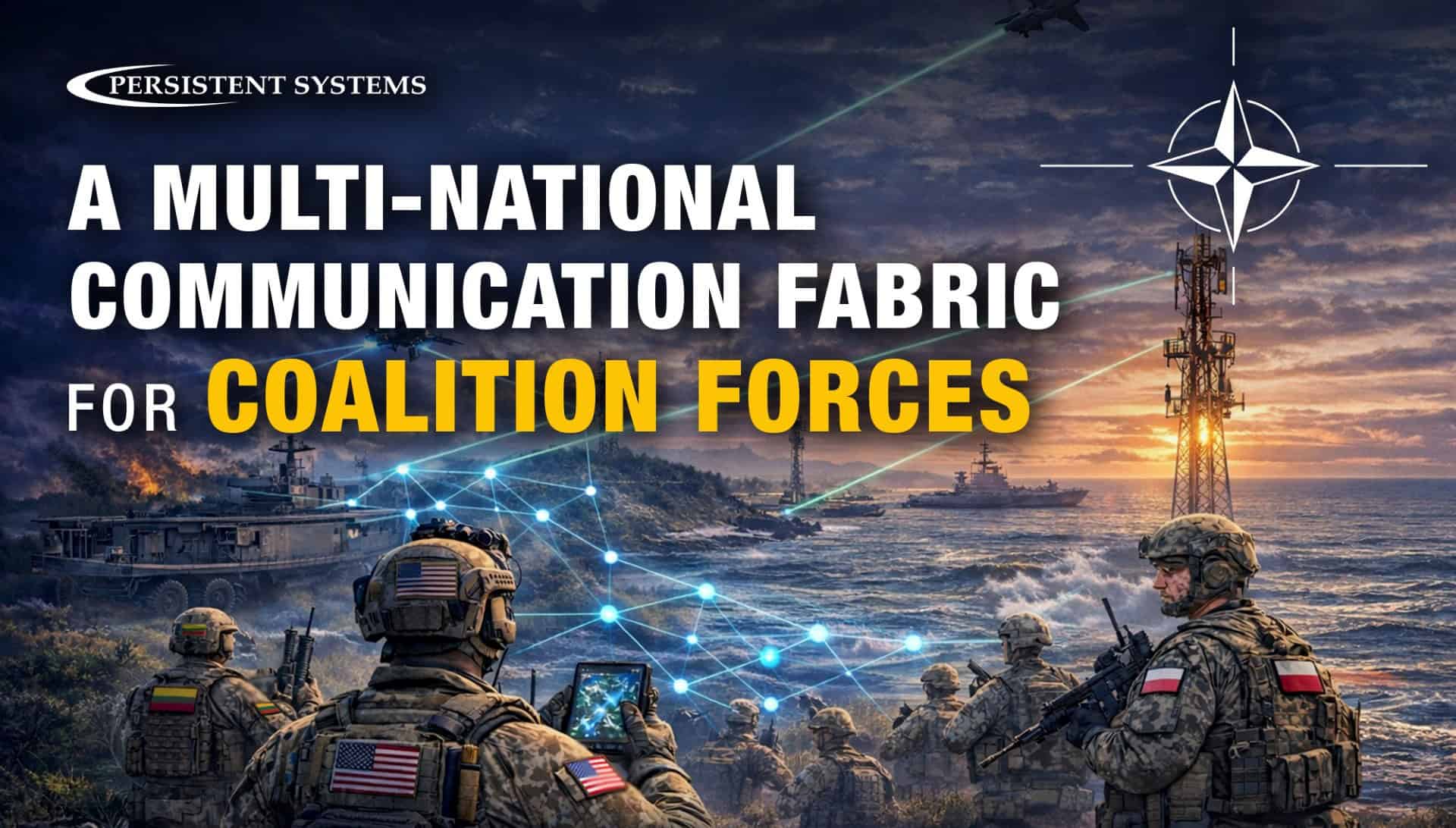
The war in Ukraine has taught us a brutal lesson about the importance of communication for command and control in large-scale combat operations. The multinational effort to arm, train, and sustain Ukraine has exposed interoperability gaps among NATO allies and their systems. The old way of fighting, where every nation brings its own communications infrastructure, is obsolete.
Today, a quiet revolution is taking place along the 2,500-mile coastline of the Baltic Sea that answers this challenge. It is not just a new radio or a better antenna. It is an architectural shift in how coalition forces interoperate across a battlefield network.
The Interoperability Dilemma
For decades, NATO commanders have chased the “holy grail” of interoperability. The goal is simple: NATO forces should be united on a network enabling multi-national communication and interoperability. As more nations enter the operational area, the network fabric becomes denser and more resilient. A communication network that delivers the same strength and deterrence as the NATO alliance itself.
But in practice, this has been impossible. The barrier is due to a combination of both technology and trust. No nation is willing to share all its sensitive data with another, even a coalition partner. The risk of compromised intelligence is too high. So, we revert to the status quo: US Forces build their own communication network, host nations build theirs, and the RF spectrum becomes a crowded, fragile, fractured mess of self-interference.
Sovereignty in a Shared Network
Persistent Systems, LLC has developed an architecture that enables multinational forces to operate on a common Wave Relay® mobile ad hoc network (MANET) while ensuring the privacy of sensitive national data.
Our approach is built on a “Two Key” multi-layer security model that separates data security and network security.
- Key One: The Transport Layer. This key establishes the network, allowing radios from the USA and NATO partner forces to form a network connection and route information. It turns every vehicle, soldier, and tower into a repeater. If an American unit drives out of range of its own base, its signal simply hops through a nearby allied radio to get back home. The physical infrastructure, the towers and relays, becomes a shared utility, available to all friendly NATO forces.
- Key Two: The Data Layer. This is where sovereignty lives. The data traveling within those packets is encrypted with a second encryption key, unique to each nation. An allied communication tower might route a US video stream, but it cannot see or interact with the video beyond simply forwarding it to the next node. It is like a mail service where the post office delivers the message, but only the sender and receiver know what’s inside the package.
Multi-National Security
This is not a theoretical exercise; the technology exists. The “Infrastructure-based Regional Operation Network” (IRON) across the Baltics is already erasing borders for friendly data, while keeping national secrets under lock and key.
Persistent Systems is leveraging its National Security Agency (NSA) Commercial Solutions for Classified (CSfC) and National Information Assurance Partnership (NIAP) compliant MACsec encryption component to add this second layer of data security to the Wave Relay® MANET. NIAP validations are accepted by 36 member nations for protecting multinational data among European and Indo-Pacific nations.
For allied forces, this delivers a strategic advantage. Instead of spending precious time setting up a new communications infrastructure, they can now land in allied territory and swiftly establish communication utilizing infrastructure already in place. They can communicate across a shared regional network, while their sensitive data remains safe and private to their team. They have a unified, resilient mesh network that spans the continent. If the enemy jams one node, the data flows around it. If the enemy targets a command post, the network heals and reroutes. A network, like a multi-national force, that is truly “stronger together.”
This is the future of coalition warfare. It allows NATO to finally fight as one force. By solving the privacy paradox, we have turned the Baltic Sea from a vulnerability into a secure vantage point. We are no longer just sharing ground; we are sharing the spectrum, and in the modern age, that is the only ground that matters.
For more information on our Wave Relay® multi-layer security architecture, please reach out to your Persistent Systems representative. This capability will be made available via a firmware update, which is available at no cost to our existing customers. While security is often seen as an impediment to operations, at Persistent, we see it as an enabling technology to facilitate enhanced coalition warfare. Get connected, stay secure, and dominate the operational environment.
###
To learn more about Persistent Systems, please visit our website at www.persistentsystems.com or follow us on any social media!
LinkedIn: Persistent Systems, LLC
Instagram: @Wave Relay
Facebook: Persistent Systems, LLC
Twitter: @PSWaveRelay
YouTube: @PSWaveRelay